Wednesday, January 19, 2011

JRuby on Rails on Amazon Elastic Beanstalk

Amazon this week announced Elastic Beanstalk, a managed Tomcat service for AWS. Naturally, I had to try JRuby on it.

First, the bad:
  • AWSEB is really slow to deploy stuff. Several times it got "stuck" and I waited for more than 30 minutes for it to recover. It did not appear to be an app issue, since the app came up just fine.
  • The default instance size is t1.micro. I was able to get a Rails app to boot there, but it's a very underpowered size.
  • It appears to start up JVMs with 256MB of memory max and 64MB of permgen. For a larger app, or one with many Rails instances, that might not be enough. For a "threadsafe" Rails app, though, it's plenty.
  • The default EC2 load balancer for the new Beanstalk instance is set to ping the "/" URL. If you don't rig up a / route in your Rails app (like I forgot to do) the app will come up for a few minutes and immediately get taken out.
And the good news: it works great once you get past the hassles! Here's the process that worked for my app (assuming app is already build and ready for deploy).

Preparing the app:
  • Ensure jruby-openssl is in Gemfile. Rails seems to want it in production mode.
  • Edit config/environments/production.rb to enable threadsafe mode.
  • `warble`
Preparing Elastic Beanstalk:
  • Create a new instance, specifying the .war file Warbler created above as the app to deploy
  • There is no step two
Once the instance has been prepared, you'll probably want to resize it to something larger than t1.micro if it's meant to be a real app...but it should boot ok.


Have fun!

Saturday, October 31, 2009

Missed RubyConf? Attend Qcon's Ruby Track!

This year, RubyConf reportedly reduced their attendee cap to 250 people (Update: actually 450 people), after hosting a 500 to 600-person conference last year. As you can imagine, this meant a lot of people that wanted to attend were not able to get tickets. To complicate matters, the RubyConf registration site happened to go live during the middle of the night EU time, and by the time most Europeans woke up it was already sold out. What's a Rubyist to do?

Well there's another option. Working with Ryan Slobojan of InfoQ and the organizers of Qcon San Francisco, I'll be hosting a one-day Ruby track the day before RubyConf! Qcon's main conference runs Wednesday through Friday, with my track on Wednesday, November 18th.

And now the REALLY good news! Because we wanted this to be a fallback for folks that could not attend RubyConf, we realized that the full conference fee was simply too high (ranging from $1500 up). So to make it possible for people to attend just the one day Ruby track, you can register with the code "rubywednesday" to get a drastically reduced $350 one-day conference pass. And to sweeten the deal even more, you can pop over to other tracks and attend the keynotes that day. Yes Virginia, there is a Santa Claus!

Those of you attending RubyConf are also welcome to attend this one-day track as well; most of the presentations won't overlap. Here's the lineup, including a special opening presentation by Yukihiro Matsumoto himself!

10:20 - "The Many Facets of Ruby" track opening by me
Ruby has seen a dramatic growth in popularity over the last few years, and there are now many facets to the Ruby story - multiple implementations, game-changing web frameworks, and large-scale use in enterprise solutions. Join us as we explore many aspects of Ruby in today's world.

10:30 - "Why we love Ruby?" by Yukihiro Matsumoto
Why we love Ruby? I have asked myself this question repeatedly. In this presentation, I will disclose my answer as of 2009. The keyword is QWAN.

11:45 - "Basking in the Limelight" by Paul Pagel
Limelight is Ruby on the desktop. Build applications with multiple windows, or just one window. Take control of the desktop, or play nicely with the desktop. Create fun animated games, or productive business apps. Develop rich internet applications, or unwired apps to make you rich. Publish your apps on the internet, or keep them for you and your friends. Do all this, writing nothing but Ruby code, in Limelight.

13:45 - "You've Got Java in my Ruby" by Thomas Enebo
JRuby is now well-established as a popular alternative implementation of Ruby.But why would you want to use it? How can it help you? This talk will detail some of the more interesting differences and advantages of using JRuby. Expect to get a better understanding of how Java makes a faster and more stable Ruby as well as how you can leverage Java features as an extra set of tools for your project.

15:00 - "Rails 3" by Yehuda Katz
I don't have a full abstract for this, but it's what you might expect...an overview of why Rails 3 is really "growing up" the framework, making it more clearly componentized and easier to adapt to more complicated (dare I say "enterprise") applications in the future. In working with Yehuda I know he's also paid special attention to performance.. Rails 3 is going to be excellent.

16:30 - "Rails in the Large: How Agility Allows Us to Build One of the World's Biggest Rails Apps" by Neal Ford
While others have been debating whether Rails can scale to enterprise levels, we've been demonstrating it. ThoughtWorks is running one of the largest Rails projects in the world, for an Enterprise. This session discusses tactics, techniques, best practices, and other things we've learned from scaling rails development. I discuss infrastructure, testing, messaging, optimization, performance, and the results of lots of lessons learned, including killer rock-scissors-paper tricks to help you avoid babysitting the view tests!


I think it's going to an outstanding track, and I'd probably pay the $350 just to see Matz speak if I knew I wouldn't get another chance for a long time. Limelight looks like an outstanding way to build rich client apps using JRuby, and of course you know I like JRuby. Tom will show some of the latest advancements we've done in JRuby, including the ability to produce "real" Java classes at runtime for integrating with Java frameworks better. Rails 3 I've described above, but you really have to see Yehuda present it himself. And of course everyone would like to know how to scale Rails to the moon...Neal knows his stuff.

Here's the track page: The Many Facets of Ruby

And the full conference schedule for Wednesday.

And finally, the registration page (don't forget to use code "rubywednesday").

I really hope to see you all there, so you can get your Ruby conference fix this fall. Tell your friends and let me know if you have any questions!

Friday, September 11, 2009

Announcing JRubyConf 2009

Good news everybody! We're finally going to have JRubyConf!

After over 3 years of heavy development, dozens of deployments and hundreds of users, it's time for a conference for JRuby users. We've talked about it on the JRuby mailing lists, polled users, and seen other JRubyists do the same. And the chorus slowly grew: you all wanted JRubyConf more and more.

Now, thanks to Engine Yard, who's producing the conference, and to sponsors EdgeCase and ThoughtWorks, we'll host the first ever JRubyConf the day after RubyConf, on Sunday November 22nd. This should allow folks attending RubyConf to also attend JRubyConf and not have to schedule a separate trip.

So here's the details:
What: JRubyConf 2009 (the first ever!)
When: Sunday, November 22nd; the day after RubyConf 2009
Where: Same hotel as RubyConf, the Embassy Suites at San Francisco Airport. You don't even have to switch locations!
Why: Because we love you!
Price: FREE!!!
We've been putting together a wide range of talks and speakers, from the JRuby core team members to real-world users; from the latest on deploying Rails to gaming and desktop development. It's going to be a fast-paced event with something for everyone, and best of all, it's FREE!

Space is limited for the event, and you will have to register separately from RubyConf to secure your seat (but you don't have to go to RubyConf to attend JRubyConf!). Check out www.jrubyconf.com for information, registration, and so on, and be quick about it!

See you at JRubyConf 2009!

Wednesday, August 26, 2009

Introducing Surinx

In June of this year, I spent a few hours formulating a dynamic cousin to Duby. Duby, if you don't remember, is a static-typed language with Ruby's syntax and Java's type system. Duby supports all Ruby's literals, uses local type inference (only argument types *must* be declared), and runs as fast as Java (because it produces nearly identical bytecode). But with the advent of invokedynamic, Duby needed a playmate.

Enter "Juby". Juby is intended to be basically like Duby, in that it uses Java's types and Ruby's syntax. But it takes advantage of the new invokedynamic opcode to be 100% dynamic. Juby is a dynamic Duby, or perhaps a dynamic Java with Ruby syntax. It's not hard to comprehend.

But the name was a problem. Juby sounds like "Jewbie", a pejorative term for a Jewish person. So I sent out a call for names to the Twitterverse, ultimately ending up with far more names than I could choose from.

The name I have chosen, Surinx, has a simple story attached. You see, when James Gosling created Java, he originally named it "Oak", after the tree outside his window. So I followed his lead; the tree (a bush, really) outside my window is a lilac, Syringa vulgaris. The genus "Syringa" is derived from New Latin, based on a Greek word "surinx" meaning "shepherd's pipe" from the use of the Syringa plant's hollow stems to make pipes. Perhaps Surinx is building on the "hollow stem" of the JVM to produce something you can smoke (other dynamic languages) with. Combined with its cousin "Duby", we have quite a pair.

And in other news, the simple Surinx implementation of "fib" below (identical to Ruby) manages to run fib(40) in only 7 seconds on current MLVM (OpenJDK7 + invokedynamic and other tidbits), a five-fold improvement over JRuby's fastest mode (jruby --fast).

def fib(a)
if a < 2
a
else
fib(a - 1) + fib(a - 2)
end
end

Given that JRuby has started to support invokedynamic, the solid performance of Surinx bodes very well for JRuby's future.

Please welcome Surinx to your language repertoire!

Sunday, August 2, 2009

Which Deployment for JRuby on Rails?

We often get the question "which deployment option is the best for JRuby on Rails?" The truth is that it depends on what you need out of deployment.

If you have a fairly straightforward Rails app without a lot of service dependencies and a greenfield deployment target, your best bet is probably the GlassFish gem right now. It performs really well, can handle high loads and high concurrency, and automatically detects Rails' threadsafe mode, scaling better when it's turned on. I'm no longer a Sun employee, and I still think the GF gem is an outstanding piece of work. Here's my howto on GF gem + JRuby on Rails + Apache. Update: Here's information on using Capistrano with the GlassFish gem.

If you have an existing Java EE or web container like Tomcat, JBoss, GlassFish, WebLogic, or WebSphere, you want to look into Warbler. Warbler packages your application as a .war file, suitable for deployment on any of these standard servers. The Warbler wiki is the best place to learn about deploying with Warbler.

If you're looking for something that's somewhat greenfield but also needs more advanced services like scheduled asynchronous jobs, web services, and some level of EE integration, you should look at JBoss's TorqueBox, a customized JBoss specially tailored for deployment of Rack-based apps (like Rails) on JRuby.

If you're looking for a hosting provider that can take your app and make it "just work", then you should look into Engine Yard's JRuby cloud offering. We don't yet have it 100% ready to go, but it won't be long and it will be fantastic. For now you can give us some direction and input on what that hosting/cloud should look like.

All told, there's a lot of great options for JRuby deployment, and no one of them is going to be perfect for everyone. Choose wisely, and join the JRuby mailing lists if you have questions.

Saturday, August 1, 2009

Return of Ruboto!

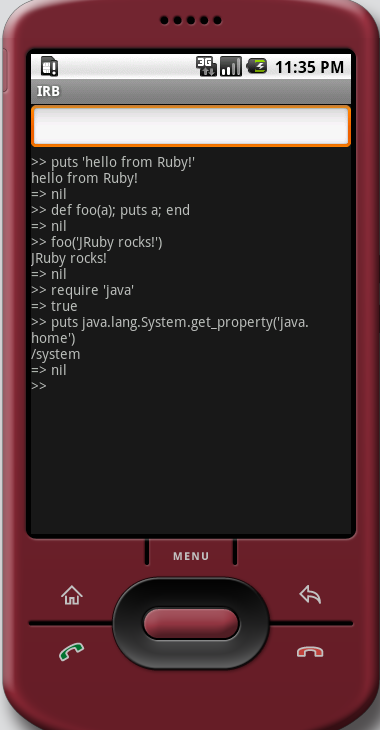
It's been a while since I was able to work on JRuby's Android support, but tonight I managed to finally circle back. And I've got something much more impressive working today: a real IRB application!


(And yes, this works just fine on the phone too)

It turned out to be incredibly easy to get this working. I'm not using any stinking plugin because they all seemed to just get in my way. So I generated a dummy application using the "android" tool, dropped the jruby jar in "libs", wrote up a quick interactive console, built and signed it, and that's all there was to it.

JRuby turns out to work very well for this sort of thing because we have an interpreter, so we can parse and execute code dynamically. Hooray for interpreted support!

I had to tweak a couple things to work around shortcomings in Android:
  • I had to edit the dx tool to allow up to a 1024M heap, since JRuby's jar has a ton of stuff in it
  • I had to catch and swallow an ArrayIndexOutOfBounds exception coming out of Dalvik's enum support. Bug!
This is of course a proof-of-concept. Writing full applications in Ruby isn't far behind, but we'll need a couple adjustments to JRuby to support it well:
  • Ability to run 100% precompiled with no runtime code generation
  • Strip out parser, interpreter, compiler, and bytecode-generation bits to shrink the jar
  • Tidy up the AOT compiler and wire it into the app build process
  • Generate some Ruby stub logic for the Android APIs, so they'll work well from Ruby
  • Strip down the weirder and wilder Ruby features (eval, etc) to allow fastest-possible execution
I know how to do all of this.

I've pushed ruboto-irb to Github so you can check it out and play with it. I welcome contributors :)

Ruboto lives!

Update: Good news, everyone!

First, the two bugs I've encountered have both been previously reported and are due to be fixed in an upcoming Android release. They are the enum bug and the reflection bug.

Second, someone going by the handle of "Psycho" reports in the comments that the next version of the Android Scripting Environment (ASE) will include JRuby support! Of course I'm interested in more than just scripting applications with JRuby...I'd like to be able to write applications using only Ruby code, so I'll continue working on this. But JRuby support seems to be coming in from all directions.

Tuesday, July 28, 2009

JVM Language Summit Call for Participation

I should have blogged this sooner, but things have been a little...crazy...lately.

The JVM Languages Summit is coming up for its second year. The event last year was spectacular; representatives of all the major languages and several minor ones showed up and talked about their plans, their history, and their desires from the JVM. And JVM engineers from the three major vendors (Sun, IBM, Oracle) sat there and dutifully took notes. It was a great meeting of minds, and an incredibly uplifting event for those of us invested in the JVM.

It's also not just an event for implementers; if you're keen on the nitty-gritty details of JVM languages and want to help improve them, promote them, or otherwise relate to them in some way, you should be here.

Hope to see you at the Summit!


=== CALL FOR PARTICIPATION -- JVM LANGUAGE SUMMIT, September 2009 ===

http://jvmlangsummit.com/

Dear colleague;

We are pleased to announce the the 2009 JVM Language Summit to be held at Sun's Santa Clara campus on September 16-18, 2009. Registration is now open for speaker submissions (presentations and workshops) and general attendance.

The JVM Language Summit is an open technical collaboration among language designers, compiler writers, tool builders, runtime engineers, and VM architects. We will share our experiences as creators of programming languages for the JVM and of the JVM itself. We also welcome non-JVM developers on similar technologies to attend or speak on their runtime, VM, or language of choice.

The format this year will be slightly different from last year. Attendees told us that the most successful interactions came from small discussion groups rather than prepared lectures, so we've divided the schedule equally between traditional presentations (we're limiting most presentations to 30 minutes this year) and "Workshops". Workshops are informal, facilitated discussion groups among smaller, self-selected participants, and should enable "deeper dives" into the subject matter. There will also be impromptu "lightning talks".

We encourage speakers to submit both a presentation and a workshop; we will arrange to schedule the presentation before the workshop, so that the presentation can spark people's interest and the workshop will allow those who are really interested to go deeper into the subject area. Workshop facilitators may, but are not expected to, prepare presentation materials, but they should come prepared to guide a deep technical discussion.

The Summit is being organized by the JVM Engineering team; no managers or marketers involved! So bring your slide rules and be prepared for some seriously geeky discussions.

The registration page is now open at:

http://registration.jvmlangsummit.com/

If you have any questions, send inquiries to inquire@jvmlangsummit.com.

We hope to see you in September!